
High-Desert Radiation and UV Degradation
Boondocking in Southern New Mexico—specifically near Las Cruces, Deming, and the Organ Mountains—subjects your rig to some of the highest UV indices in North America. At an average elevation of 4,000 feet, the solar radiation is not only a benefit for your 800W+ solar array but a threat to your rig's exterior components. In 2026, the technical standard is to replace all standard plastic roof vents with UV-stabilized polycarbonate or aluminum alternatives. For your tires, 'Tire Covers' are not optional; the New Mexico sun will cause 'Sidewall Checking' and ozone cracking within a single season of stationary boondocking. We recommend treating all rubber seals with a 303 Aerospace Protectant every 30 days to maintain the structural integrity of your slide-outs and window seals.
Wind-Load Mathematics: Surviving the 'New Mexico Blow'
Southern New Mexico is famous for its sudden, high-velocity wind events, often gusting to 60+ MPH. For RVers with large solar arrays, these winds can create significant 'Lift' or 'Downforce' depending on the rig's orientation. The technical boondocker must calculate the 'Wind Load' on their panels. For a standard 200W panel (approx. 15 sq ft), a 60 MPH wind can exert over 200 lbs of force. In 2026, the 'Professional Build' utilizes 'VHB Tape' combined with mechanical well-nuts or through-bolts with backing plates. Avoid 'Z-Brackets' that only use self-tapping screws into thin fiberglass. When a wind event is predicted, always orient the rig's 'Nose' into the wind to minimize the surface area and prevent the 'Sail Effect' from rocking the chassis or ripping off the awning.
Restricted Area Buffers and SIGINT Interference
Southern New Mexico is home to White Sands Missile Range, Holloman AFB, and various research facilities. Boondocking near these areas (e.g., the BLM land adjacent to the WSMR boundary) involves unique electronic constraints. You are often in an 'RF-Dense' environment where the military utilizes high-power jamming or signal intelligence (SIGINT) equipment. This can cause 'GPS Jamming' where your rig's navigation or Starlink GPS lock may fail. In 2026, the expert solution is to utilize a 'Dead Reckoning' secondary GPS module or a high-stability external GNSS antenna that can filter out out-of-band interference. Always check the 'NOTAMs' (Notices to Air Missions) for the region; if there is a 'GPS Interference Testing' advisory, expect your satellite connectivity to be intermittent.
Water Scarcity and Alkalinity Engineering
The water sources in Southern New Mexico are notoriously alkaline and often contain trace amounts of arsenic or high levels of fluoride. If you are filling your 100-gallon fresh tank in Deming or Lordsburg, a simple 'Blue Filter' is insufficient. For the 2026 veteran, a 3-stage filtration system including an 'Activated Alumina' filter (specifically for fluoride/arsenic removal) is required for safety. Furthermore, the low humidity (less than 10%) in the southern desert leads to rapid evaporation. To conserve water, utilize 'Low-Flow' aerators on all faucets and a 'Recirculating' shower pump that filters and reheats the same 3 gallons of water for an 'unlimited' duration—a technical marvel that is becoming the standard for 14-day desert stays.
Legal Compliance: The 2026 NM State Land Interface
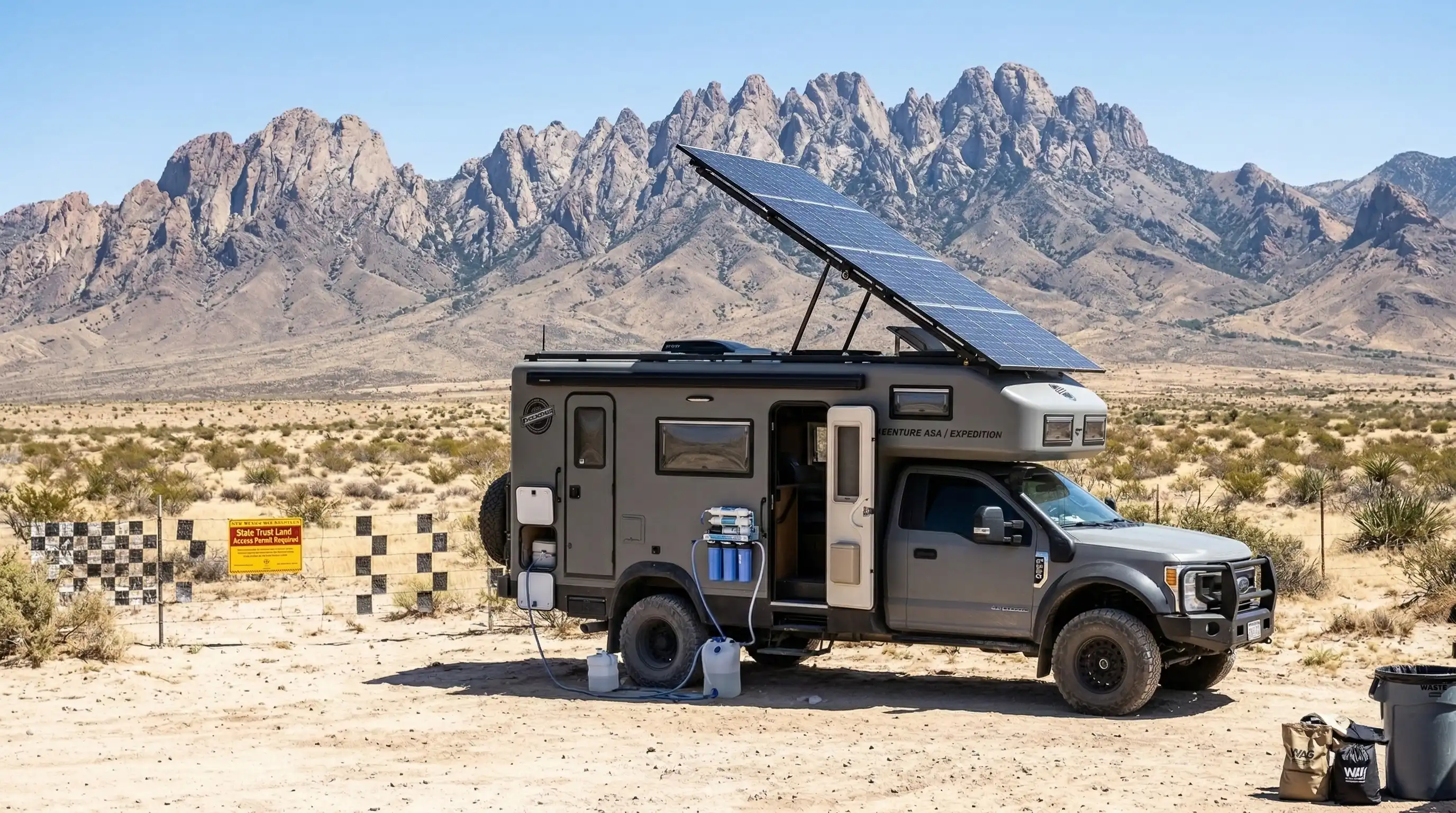
In New Mexico, BLM land is frequently 'checkerboarded' with State Trust Land. Unlike BLM land, New Mexico State Trust Land requires a specific 'Recreational Access Permit' (typically $35/year as of 2026). If you cross an unmarked fence line from BLM into State land without this permit, you are technically trespassing and subject to immediate citation. Use the 'NM State Land Office' interactive map layer on your GIS software to verify your exact position. Furthermore, the 2026 NM BLM regulations require all 'Human Waste' to be contained; even in remote desert areas, the use of 'WAG Bags' or a sealed cassette/black tank is mandatory, with rangers now conducting 'visual inspections' of waste management systems during routine checks.