

The Fluid Dynamics of Reverse Osmosis (RO)
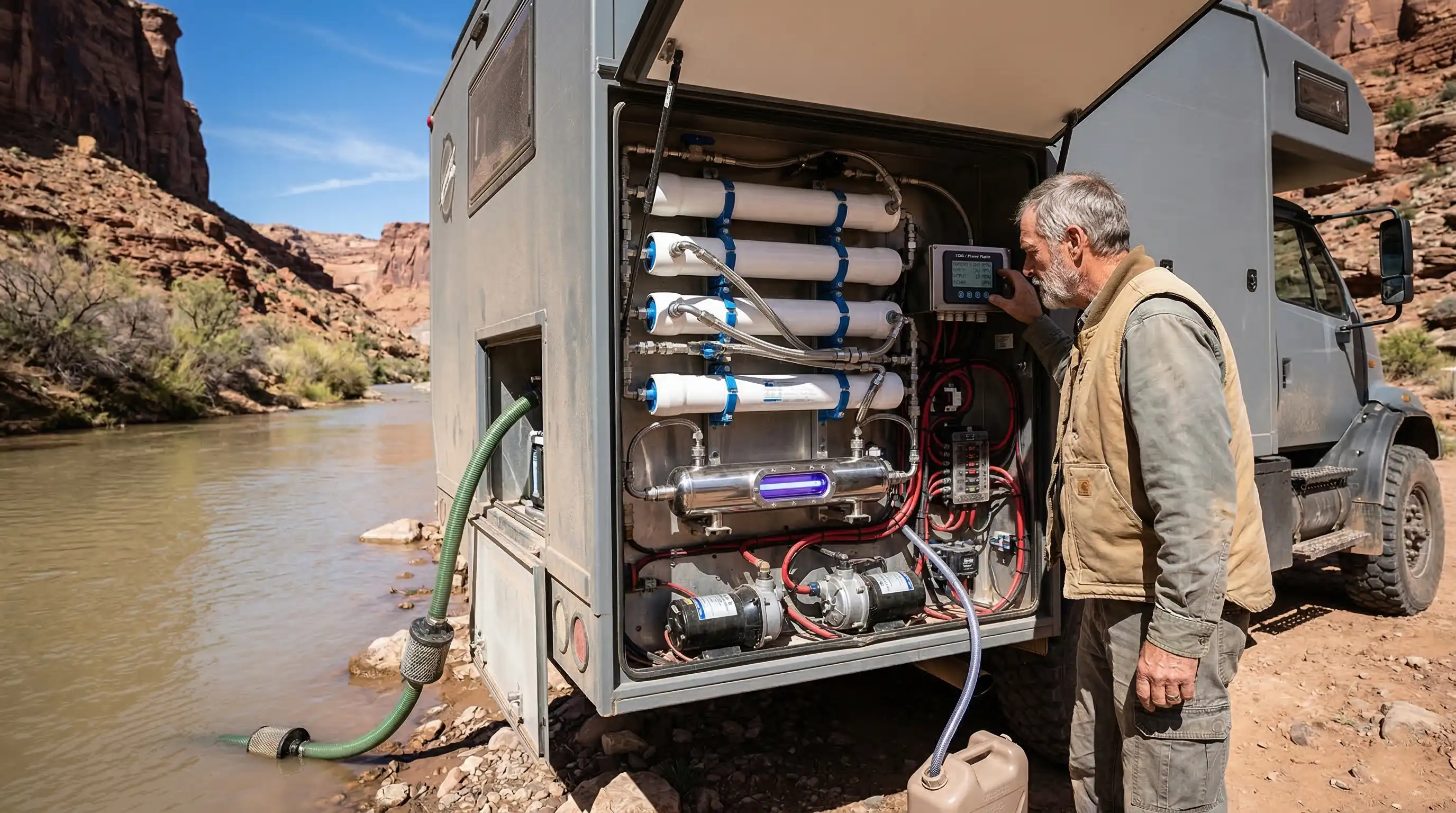
Acquiring water from intermittent streams, cattle tanks, or alkaline desert wells on BLM land is an exercise in extreme hazard mitigation. For the seasoned boondocker, basic hollow-fiber microfiltration (e.g., standard 0.1-micron inline filters) is woefully inadequate for treating agricultural runoff or high-TDS (Total Dissolved Solids) groundwater. The technical standard for 14-day autonomy is an onboard Reverse Osmosis (RO) system. RO operates on the principle of overcoming natural osmotic pressure to force solvent molecules through a semipermeable membrane. The mathematical requirement for this is the Net Driving Pressure (NDP), calculated as $NDP = (\Delta P) - (\Delta \Pi)$, where $\Delta P$ is the applied hydraulic pressure and $\Delta \Pi$ is the osmotic pressure difference. Because off-grid RO membranes require an NDP of roughly 60-80 PSI to overcome high-TDS desert water, standard RV 12V water pumps (which typically max out at 45 PSI) are insufficient. You must integrate a dedicated, high-pressure 12V booster pump (capable of 100+ PSI) into your wet bay, drawing directly from a heavy-gauge 12V or 24V bus to prevent voltage drop and ensure the membrane does not prematurely foul due to low-velocity scaling.
UV-C Pathogen Disruption Physics
While RO systems are highly effective at stripping out heavy metals, arsenic, and dissolved salts, absolute biological security requires a secondary sterilization vector. In 2026, chemical treatment (like chlorine dioxide) is considered obsolete for high-end rigs due to the introduction of off-tastes and chemical logistics. The expert utilizes ultraviolet germicidal irradiation (UVGI). By passing the filtered water through a quartz-sleeved chamber containing a UV-C LED emitting at exactly 254 nanometers, the high-energy photons penetrate the cellular walls of bacteria, viruses, and cysts (like Giardia and Cryptosporidium). The photons induce the formation of thymine dimers in the microorganisms' DNA/RNA, halting cellular replication. However, the efficacy of UV-C is strictly dependent on flow rate and water turbidity. The water *must* be pre-filtered to at least 1 micron to prevent pathogens from hiding in the 'shadows' of particulate matter, and the flow rate must be mathematically restricted (often to 1-2 Gallons Per Minute) to guarantee the adequate millijoule per square centimeter ($mJ/cm^2$) exposure dosage required for a 99.99% log reduction.
TDS Management and High-Alkaline Environments
The vast tracts of BLM land in Nevada, Utah, and Arizona are notorious for highly alkaline groundwater, often featuring TDS readings exceeding 1,200 ppm (parts per million). Pumping this water directly into your 100-gallon fresh tank will rapidly calcify tankless water heaters, destroy faucet cartridges, and lead to kidney stress. The expert boondocker carries a digital TDS pen calibrated with a NaCl standard solution. Before deploying the primary intake hose, the source water is analyzed. If the water exceeds 500 ppm, it must be routed through a portable water softener (utilizing an ion-exchange resin to swap calcium and magnesium ions for sodium ions) *before* it hits the RO membrane. This vital pre-treatment stage prevents the microscopic pores of the thin-film composite (TFC) RO membrane from scaling over and permanently failing within a single week of high-desert operation.
Brine Discharge and Graywater Legalities
The dark secret of Reverse Osmosis is the 'brine' or 'reject water'. For every gallon of purified water produced, a mobile RO system typically ejects 2 to 3 gallons of high-concentration wastewater. When operating on BLM land, discharging this brine presents a severe legal and environmental challenge. Under 43 CFR Part 8365, discharging graywater that creates an 'unsanitary condition' or damages natural resources is a finable offense. Dumping highly concentrated, hyper-saline brine onto fragile cryptobiotic soil or near native flora will sterilize the earth and violate Leave No Trace mandates. The technical workaround is a 'Brine Recirculation Loop'. By capturing the reject water and routing it back into the primary holding tank of the raw source water (if drawing from an external bladder or temporary pool), you dilute the immediate environmental impact. Alternatively, the brine must be routed directly into your rig's black or gray holding tanks, to be transported out of the BLM district and dumped at an authorized municipal facility.
Pump Energy Budgets and Starlink Automation
Purifying 50 gallons of water through a high-pressure RO and UV-C array is a highly energy-intensive process. A 100 PSI booster pump and an active UV-C ballast can continuously draw up to 15 Amps at 12V. Running this system for the hours required to fill a large tank will rapidly deplete a lithium battery bank. Veterans integrate their water purification electrical relays into their central GX communication hubs. Using Starlink remote access, the purification sequence is automated to trigger *only* during peak solar insolation (typically between 11:00 AM and 2:00 PM). This ensures that the heavy electrical load of the high-pressure pumps is powered directly by the excess energy cascading from the MPPT charge controllers, rather than draining the LiFePO4 storage capacity required to survive the long, dark, off-grid nights.