

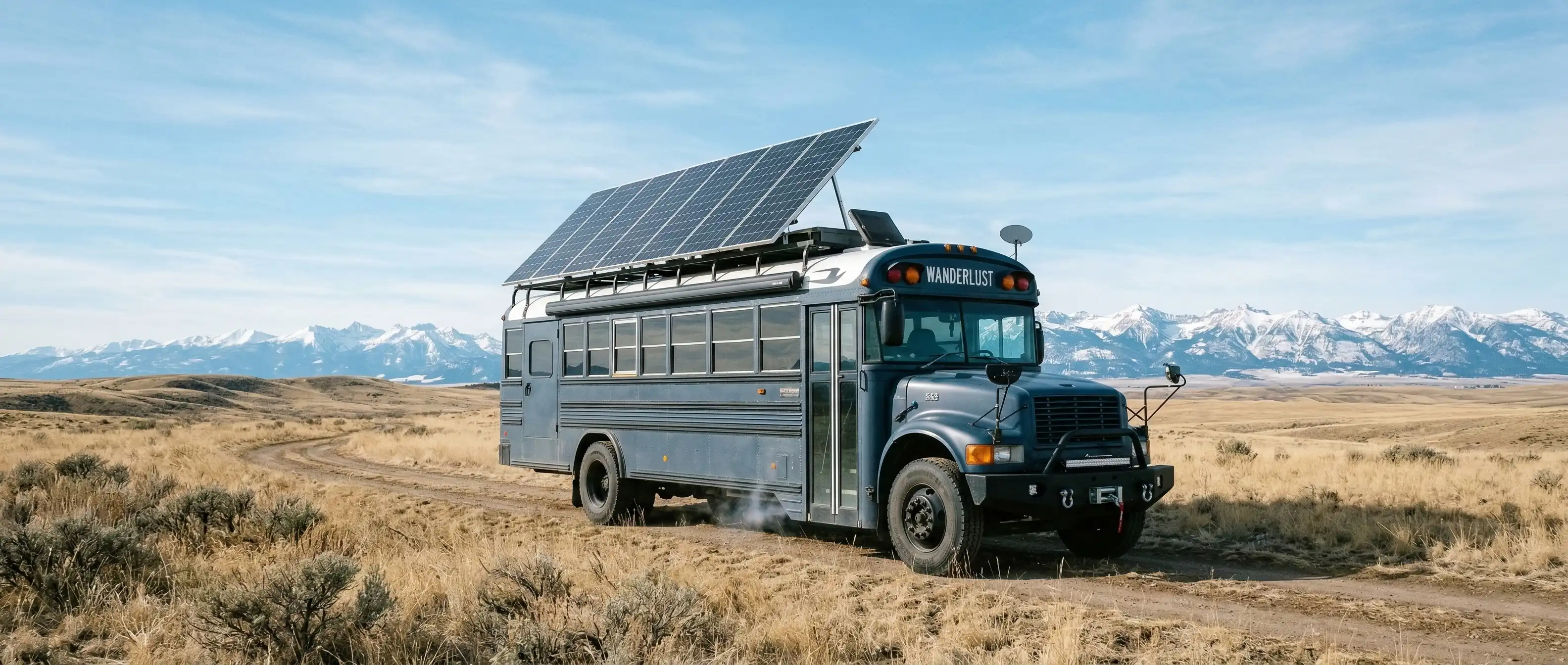
High-Latitude Solar Mechanics in Montana
Boondocking in Montana, especially during the shoulder seasons, requires a rethink of your solar array's geometry. At 47°N latitude, the 'Sun Path' is significantly lower on the horizon compared to the desert Southwest. A flat-mounted rooftop array will lose approximately 40% of its potential output due to cosine error. For the expert boondocker, 'tilted' panels are a necessity. By angling your panels at 50-60 degrees during the spring and fall, you can maximize the direct normal irradiance (DNI). In 2026, we also see the rise of bifacial solar panels in Montana. When used over snow-covered ground, the 'Albedo Effect' can provide up to a 20% gain in charging current from the reflected light hitting the underside of the panel.
Cold-Weather Lithium Discharge Physics
While much is said about charging lithium in the cold, discharging is also a technical concern. At 0°F, the internal resistance of a LiFePO4 cell increases significantly, leading to 'voltage sag' under high-current draws (like using a microwave or induction cooktop). Even if your batteries are 'rated' to discharge at these temps, the usable capacity will drop by 20-30%. To maintain system stability, your battery bank should be housed in an insulated, 'conditioned' space. We recommend a 12V 'diversion' heater—a small resistive load that kicks in when solar production is high but the batteries are too cold, effectively using the sun to warm the bank before the heavy discharge cycles begin.
Logistics of 'Big Sky' Scouting
Montana's BLM land is often checkerboarded with state and private land. The 'Public Lands' app is a baseline, but the expert utilizes the 'CADNS' (Cadastral) layers to verify exact property lines. Montana's 'Stream Access Law' is one of the best in the nation, but it does not grant camping rights on the high-water mark of private land. Stick to the BLM-managed 'Tier 2' roads in the Missouri River Breaks or the regions south of Billings. These areas offer the best balance of solitude and the wide sky-view required for high-bandwidth Starlink operations.
Fuel Management and Diesel Heater Tuning
In the Montana high country, your diesel heater is your life support system. At elevations above 5,000 feet, the 'standard' pump pulse rate will lead to carbon buildup and a 'no-start' condition within a week. You must tune your heater's CO2 levels using a combustion analyzer. Reducing the fuel pump frequency by 10-15% will lean out the mixture, ensuring a clean, hot burn. Additionally, winter-grade diesel in Montana is often a 'Number 1' and 'Number 2' blend, but for deep-cycle reliability, adding a lubricity improver is recommended to protect the sensitive dosing pumps found in Webasto or Espar units.
Waste Management and Environmental Ethics
Montana's soil is often heavy in clay and holds moisture, making it highly susceptible to 'rutting.' If your rig weighs over 10,000 lbs, do not attempt to travel on unimproved BLM roads after a rain event. Doing so not only risks getting stuck but also permanently damages the road surface, which leads to BLM closures. For waste, the use of a 'composting' or 'diverting' toilet is the gold standard for Montana boondocking. By separating liquids from solids, you reduce your waste volume by 80%, allowing for 14-day stays without needing to locate a vault toilet or dump station.