

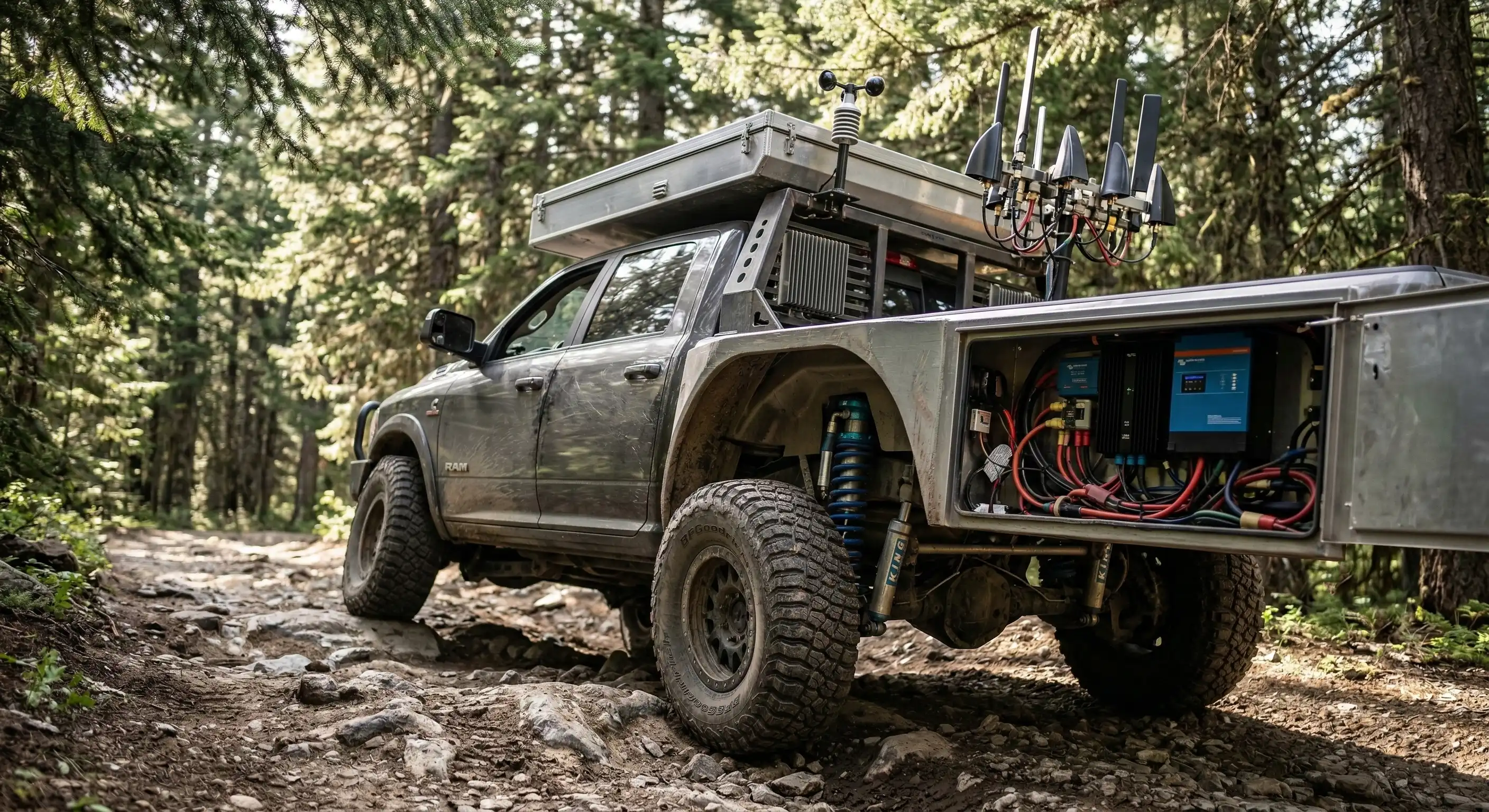
RF Signal Penetration in Idaho's Deep Canyons
The topography of Idaho, specifically around the Salmon River and the Owyhee Wilderness, creates 'RF Dead Zones' where standard cellular boosters (like the WeBoost) become ineffective due to a lack of a donor signal. In 2026, the veteran move is to move beyond cellular and lean into Starlink with a 'high-gain' modification. For those using the flat-mount Starlink High Performance dish, the key to connectivity in Idaho canyons is a custom 'telescoping mast' system. By elevating the dish 25 feet above the rig, you can often clear the immediate canyon 'shoulders' and achieve a stable connection with the Low Earth Orbit (LEO) satellites. Additionally, utilizing a 4x4 MIMO antenna array for cellular is mandatory to capture 'signal skip'—the phenomenon where RF waves bounce off canyon walls and into your receiver.
Suspension Dynamics for 'Tier 3' Roads
Idaho's BLM roads are often classified as 'unimproved,' meaning they consist of washboard gravel, large embedded boulders, and steep grades. A standard RV suspension will fail under these conditions. Experts should be running a tuned 2.5-inch or 3.0-inch internal bypass shock system (like Fox or King) to manage the high-frequency vibrations that lead to 'fastener fatigue.' Every 100 miles of Idaho backcountry driving is equivalent to 1,000 miles of highway use. We recommend a daily 'walk-around' inspection focusing on shock mount torque and the structural integrity of your solar rack mounts, which are susceptible to vibration-induced stress fractures.
Advanced Alternator Charging (DC-DC)
Because the Idaho canopy is often dense with Douglas Fir and Ponderosa Pine, solar harvest can be reduced by 60-80% for several hours a day. To compensate, your rig must be equipped with a high-amperage DC-DC charger (60A to 120A). This allows your engine's alternator to act as a 'mobile generator' while navigating between sites. At 120A, an hour of idling or driving can inject 1.5kWh into your battery bank, effectively bridging the gap during low-solar periods. Ensure your alternator is rated for this continuous load; many veterans are now installing secondary 24V or 48V alternators dedicated solely to the house battery bank to prevent 'heat soak' on the primary engine electrical system.
Managing Graywater in Riparian Zones
Idaho's BLM land is often adjacent to high-quality trout streams and protected watersheds. The legal mandate is clear: zero discharge. In 2026, the 'expert' solution is the graywater recycling system. By passing graywater through a 10-micron sediment filter and an ozone generator, the water can be reused for toilet flushing or external rig washing (away from water sources). This effectively doubles your freshwater range and eliminates the need for frequent trips to a dump station, which may be 50+ miles away in the Idaho backcountry.
Legal Compliance: The Idaho 'Stay' Limits
While the federal 14-day limit applies, many Idaho BLM districts (like the Shoshone or Coeur d'Alene districts) have localized 'No-Stay' zones near active logging operations or fire-restricted areas. It is your responsibility to cross-reference your GPS coordinates with the latest BLM 'Interactive Mapping' layer. In 2026, ignorance of a localized closure is met with immediate citations. We recommend maintaining a 'digital logbook' of your stay dates and locations, which can be presented to a ranger to prove your compliance with the 25-mile move-out rule.