
Coastal Engineering: Managing Salt-Air Corrosion
Boondocking on the California coast—specifically the limited BLM sections near the King Range or the Central Coast—presents a chemical challenge for off-grid rigs. The 'Salt Mist' found within 5 miles of the Pacific is highly corrosive to electrical terminals and aluminum solar frames. In 2026, the veteran move is to treat all exposed electrical connections with a dielectric grease or a specialized 'CorrosionX' coating. Pay close attention to your MC4 connectors on the roof; salt buildup can increase resistance, leading to heat-induced failure of the connector housing. Furthermore, coastal fog can reduce solar harvest by up to 80% for several hours a day. To compensate, a high-amperage (100A+) DC-DC charger is mandatory to replenish your battery bank during the drive between coastal sites.
The Imperial Valley LTVA: 2026 Technical Updates
The Long-Term Visitor Areas (LTVAs) like Imperial Dam and Slab City remain the mecca for winter boondocking. However, as of the 2025-2026 season, the BLM has modernized the LTVA permit system. All permits are now digital and linked to your Starlink or cellular MAC address for 'automated occupancy verification.' Technically, the Imperial Valley is one of the best locations for 'Over-Paneling.' Because the winter sun is lower, you can actually mount 1200W of solar on a 1000W-rated charge controller. This 'Oversizing' ensures you reach your bulk charging voltage earlier in the morning (around 8:30 AM) without damaging the controller, as the MPPT will simply 'clip' the excess power during the mid-day peak.
Water Desalinization and Filtration in the Desert
Water in the California desert is often high in Total Dissolved Solids (TDS), frequently exceeding 800 ppm. This 'Hard' water will ruin your RV's plumbing fixtures and tankless water heaters via scale buildup within a single season. The technical solution for the 2026 boondocker is a portable water softener paired with a 0.5-micron solid carbon block filter. If you are sourcing water from the Imperial Dam 'community' taps, use a TDS meter to verify water quality; if it exceeds 500 ppm, utilize a Reverse Osmosis (RO) system for all drinking and cooking water. This prevents the 'osmotic shock' to your body that often leads to dehydration in high-heat environments.
Desert Solar Dynamics: Dust and Albedo
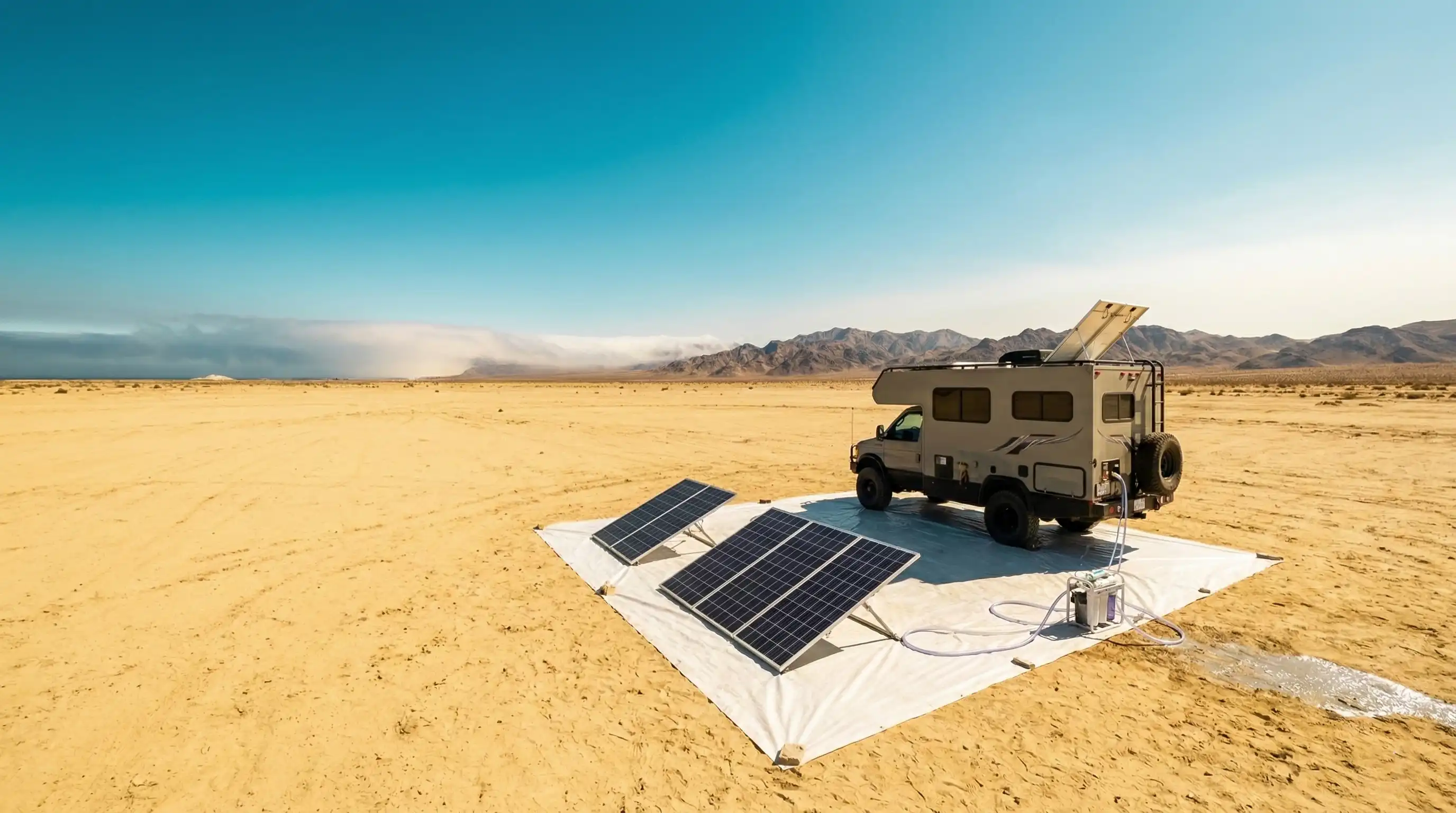
In the California High Desert (Mojave/Joshua Tree periphery), the 'Albedo Effect'—the reflection of sunlight off the light-colored sand—can actually increase the output of bifacial solar panels by up to 15%. If your rig is equipped with ground-deployable bifacial panels, position them over a white tarp or light-colored sand to maximize the rear-side gain. However, the desert 'wind-scouring' will pit the glass of your panels over time. In 2026, many veterans are applying a 'ceramic coating' (similar to automotive paint protection) to their solar panels to make them more hydrophobic and easier to clean with a simple air-compressor blow-off, rather than wasting precious water on washing.
Legal Nuances: The California Campfire Permit 2026
Even if you are not planning a fire, California law in 2026 requires a valid 'California Campfire Permit' for the use of any portable stove, including propane or butane. This is strictly enforced in BLM districts like the Alabama Hills or Trona Pinnacles. Additionally, the '150-foot rule'—which limits parking to within 150 feet of a designated road—is being enforced via satellite imagery. If your rig's coordinates are flagged outside this buffer, a citation is automatically generated and mailed to your registered address. Always cross-reference your site with the 'OnX Offroad' or 'Avenza' MVUM (Motor Vehicle Use Map) layers before leveling your jacks.