

The Physics of Unsprung Weight and Suspension Frequency
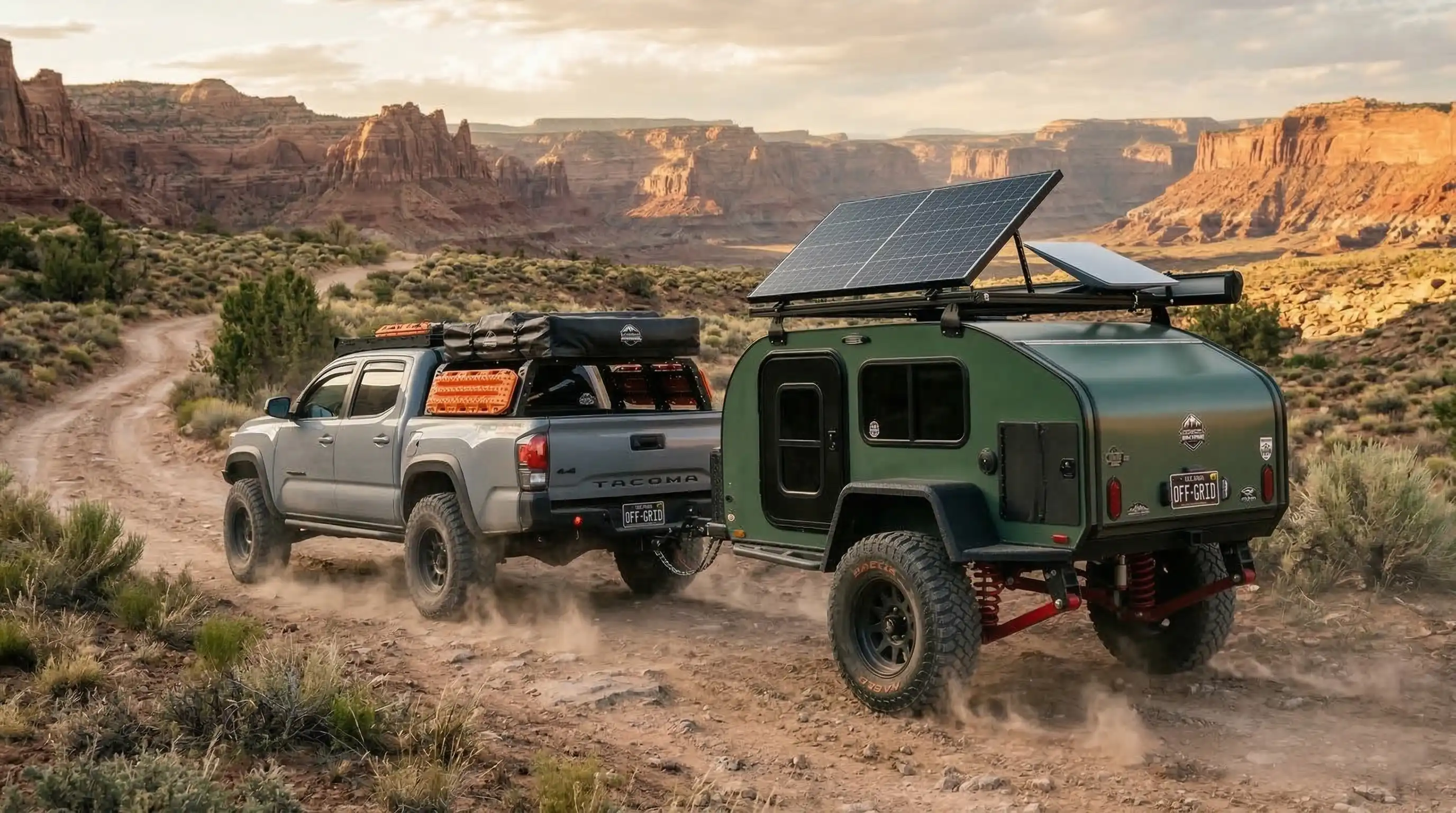
Pushing a teardrop trailer deep into Bureau of Land Management (BLM) territory, such as the jagged two-tracks of the San Rafael Swell, requires a paradigm shift from standard RV towing. The primary mechanical constraint of a micro-camper is the ratio of sprung to unsprung weight. Standard torsion axles on lightweight trailers (under 1,500 lbs dry) result in a high-frequency harmonic bounce on corrugated dirt roads, which will literal vibrate solar charge controllers and BMS (Battery Management System) boards to failure. The expert solution is an independent trailing-arm suspension, such as the Timbren Axle-Less system or Cruisemaster XT. By utilizing progressive-rate rubber springs or airbags paired with remote-reservoir shock absorbers, you decouple the wheels' kinetic energy from the chassis. This tuning drastically lowers the resonant frequency of the trailer, keeping the tires in contact with the dirt for critical braking friction and protecting your sensitive 12V electronics bay from catastrophic shock loads.
High-Density Power Architecture in Micro Volumes
The roof real estate of a teardrop is brutally limited, often capping out at 40 square feet. Relying on standard 100W monocrystalline panels is insufficient for powering a compressor fridge, diesel heater, and Starlink terminal. The 2026 standard for veteran off-grid builds is the integration of high-voltage (HV) residential solar panels (often 350W+ per panel) mounted on custom extruded aluminum load bars. Because these panels operate at a higher Open Circuit Voltage (Voc), often exceeding 40V, they mandate a high-input MPPT charge controller (e.g., Victron 100/30). This allows the panel to begin bulk charging earlier in the morning and sustain it later into the evening, maximizing the daily watt-hour harvest despite the limited footprint. Furthermore, to combat the 'heat sink' effect of the trailer's small cabin, these panels must be mounted with at least a 3-inch air gap to facilitate convective cooling, preventing the severe voltage derating that occurs when cell temperatures exceed 115 degrees Fahrenheit.
Starlink 12V DC Conversion and Flat-Mount Integration
Operating an AC inverter solely to power a Starlink terminal introduces a 10 to 15 percent thermal and conversion loss, which is unacceptable when your total battery bank is limited to 200Ah of LiFePO4. Teardrop veterans must perform a DC-to-DC conversion on their Starlink hardware. By utilizing a passive PoE (Power over Ethernet) injector and a waterproof 12V-to-48V step-up converter, the Starlink dish can be powered directly from the DC bus. For the ultimate low-profile setup, the Gen 4 dish must be removed from its automated mast and 'flat-mounted' to the teardrop's roof. While this eliminates the dish's ability to mechanically track, the high density of the LEO (Low Earth Orbit) satellite constellation in 2026 ensures that a flat, sky-facing orientation provides 99 percent uptime with significantly lower aerodynamic drag and zero moving parts to foul with Mojave dust.
Thermal Dynamics of Micro-Cabin Heating
Heating a 40-cubic-foot cabin presents a unique thermodynamic challenge: the risk of asphyxiation and the rapid accumulation of condensation. Standard 5kW diesel heaters are vastly overpowered for a teardrop, leading to 'short-cycling.' Short-cycling prevents the combustion chamber from reaching its self-cleaning temperature, resulting in severe carbon fouling on the glow plug within days. The technical mandate is to use a 2kW heater and manually tune the fuel pump's pulse-rate via the advanced settings menu to lean out the mixture, especially at elevations above 6,000 feet. Additionally, a secondary intake vent is absolutely required to prevent the cabin from becoming negatively pressurized, which can draw dangerous exhaust gases back into the sleeping quarters through microscopic gaps in the door seals.
BLM Compliance and Cryptobiotic Soil Navigation
The maneuverability of a teardrop trailer often tempts drivers to squeeze into pristine, untouched clearings. Under 43 CFR 8365.1-6, causing 'unnecessary degradation' of public lands is a strict-liability citation. In high-desert BLM zones, the primary environmental hazard is the destruction of cryptobiotic soil crusts. These living biological crusts prevent massive wind erosion. Because a teardrop's track width is often narrower than the tow vehicle's, the trailer tires can inadvertently crush vegetation outside the established two-track. Veterans must rely on their side mirrors to ensure the trailer traces the exact path of the tow vehicle. When selecting a dispersed site, you are legally and ethically bound to camp only on previously disturbed ground or durable rock surfaces, maintaining a zero-footprint approach that keeps these remote Tier 3 access routes open to the public.