

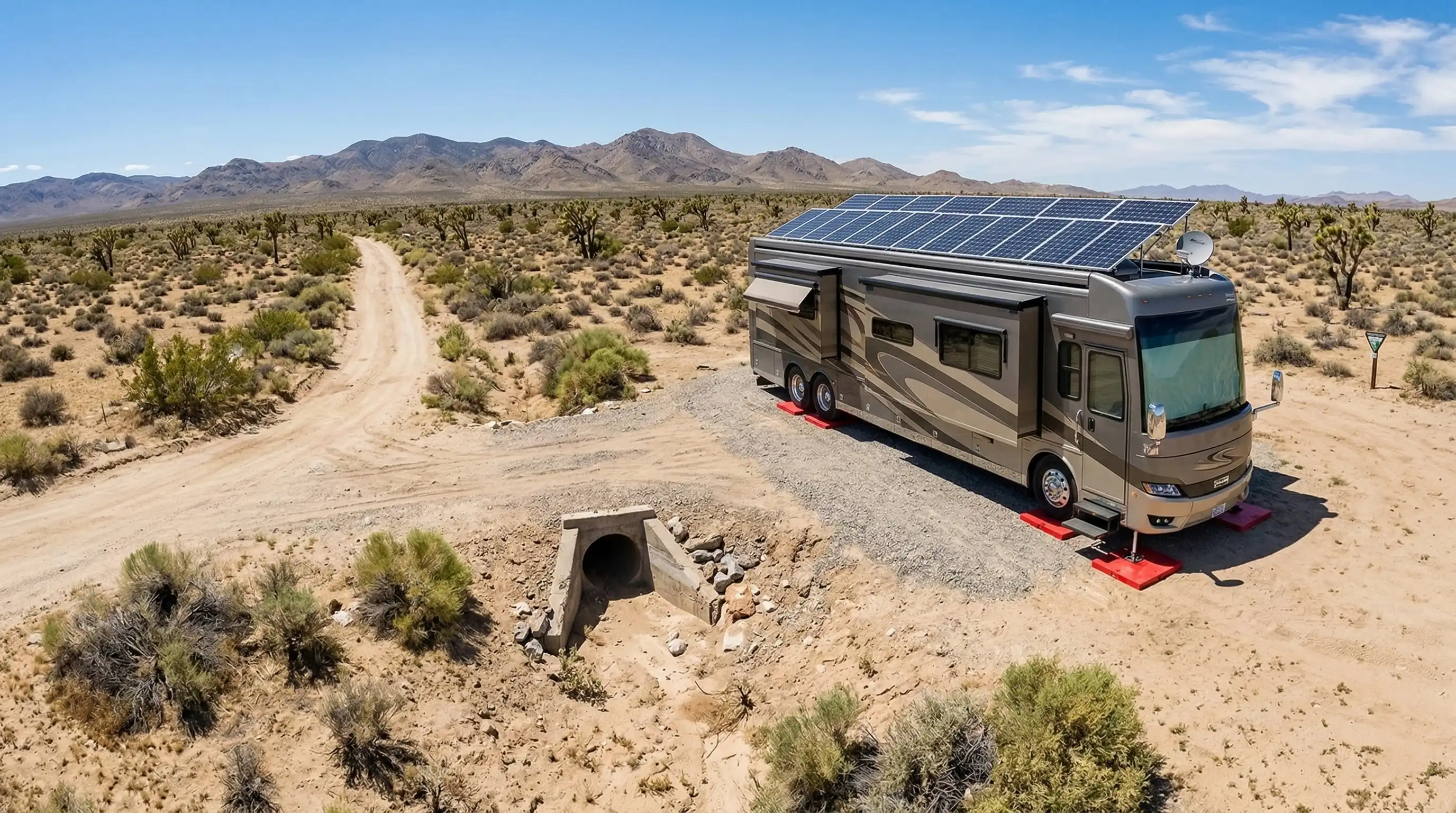
The Geometry of Ingress: Departure and Breakover Angles
For a 35-45 foot Class A or Fifth-Wheel, the primary barrier to BLM land is not the road width, but the 'V-ditch' entry. Most BLM access points from a paved highway involve a drainage culvert. The seasoned veteran must calculate their rig's 'Departure Angle'—the angle between the rear tires and the lowest point of the rear bumper. If your departure angle is less than 8 degrees, you are at risk of 'tail-dragger' damage. The technical solution is a 'Lift Kit' (for Fifth-Wheels) or a 'Skid Roller' system. However, the most effective tool is a 'Ground Scouting' walk-through, using a laser inclinometer to verify that the grade change won't high-center your rig's mid-section ('Breakover' point).
Soil Mechanics and Compaction Ratios
A 30,000lb rig exerts a massive 'Ground Pressure' (PSI). In the clay-rich soils of the Southwest (bentonite) or the soft sands of the Mojave, a large rig can 'sink' over a 14-day stay as the soil settles under vibration and weight. The expert boondocker utilizes 'Pad Mathematics.' By placing 24x24 inch jack pads under each stabilizer, you distribute the load over 576 square inches, drastically reducing the PSI. Always check the 'Soil Moisture' index. If the ground is even slightly damp, a large rig can become 'glued' to the earth through suction. The technical recovery of a 40ft rig from a BLM wash can exceed $5,000; preventative pad deployment is the only logical choice.
Turning Radius and 'The Point of No Return'
On BLM 'Tier 2' roads, the turning radius is often governed by the 'Swept Path.' For a towable, the 'cut-in' of the trailer tires can be as much as 10 feet. Veterans must utilize satellite imagery (at the 20-meter zoom level) to identify 'The Loop.' Do not enter a BLM road without a confirmed 'Bulb' or circular turnaround at the end. Utilizing a drone for a 'Pre-Flight' scout is the standard for 2026; a 3-minute drone flight can identify a 'dead-end' that would otherwise require a 2-mile backup—a dangerous maneuver for any large rig on a narrow dirt shoulder.
Power Density: Managing 24V/48V Large-Scale Systems
Large rigs have large energy demands (Residential fridges, multiple A/C units). A standard 12V system is inefficient at these scales due to 'Voltage Drop' in heavy-gauge cabling. The expert veteran migrates to a 48V architecture. This reduces the current (Amperage) by a factor of 4, allowing for 2/0 AWG wiring instead of 4/0, and significantly reducing 'Heat Loss' (I2R) in the inverter/charger. A 48V system paired with a 10kWh+ lithium bank allows for 'Micro-Grid' performance, enabling the use of soft-start A/C units for 8-10 hours without the need for a generator, provided the roof-mounted solar array is at least 1500W.
Legal Compliance and 'Occupancy' Definitions
Large rigs are often the primary targets for 'Squatter' enforcement. Under BLM 43 CFR 8365.1-6, 'Occupancy' is defined by the presence of personal property. To remain in the ranger's 'Good Graces,' ensure your site is 'Tidy.' Large rigs often sprawl; keep your 'Outdoor Living Area' within a 15-foot radius of the rig. In 2026, many BLM districts are implementing 'Rig Length' restrictions on specific forest roads. Always cross-reference your MVUM (Motor Vehicle Use Map) for 'Vehicle Length' icons. If you are over-length for a specific route, you are liable for any 'Resource Damage' (tree limb breakage, shoulder erosion) regardless of intent.