

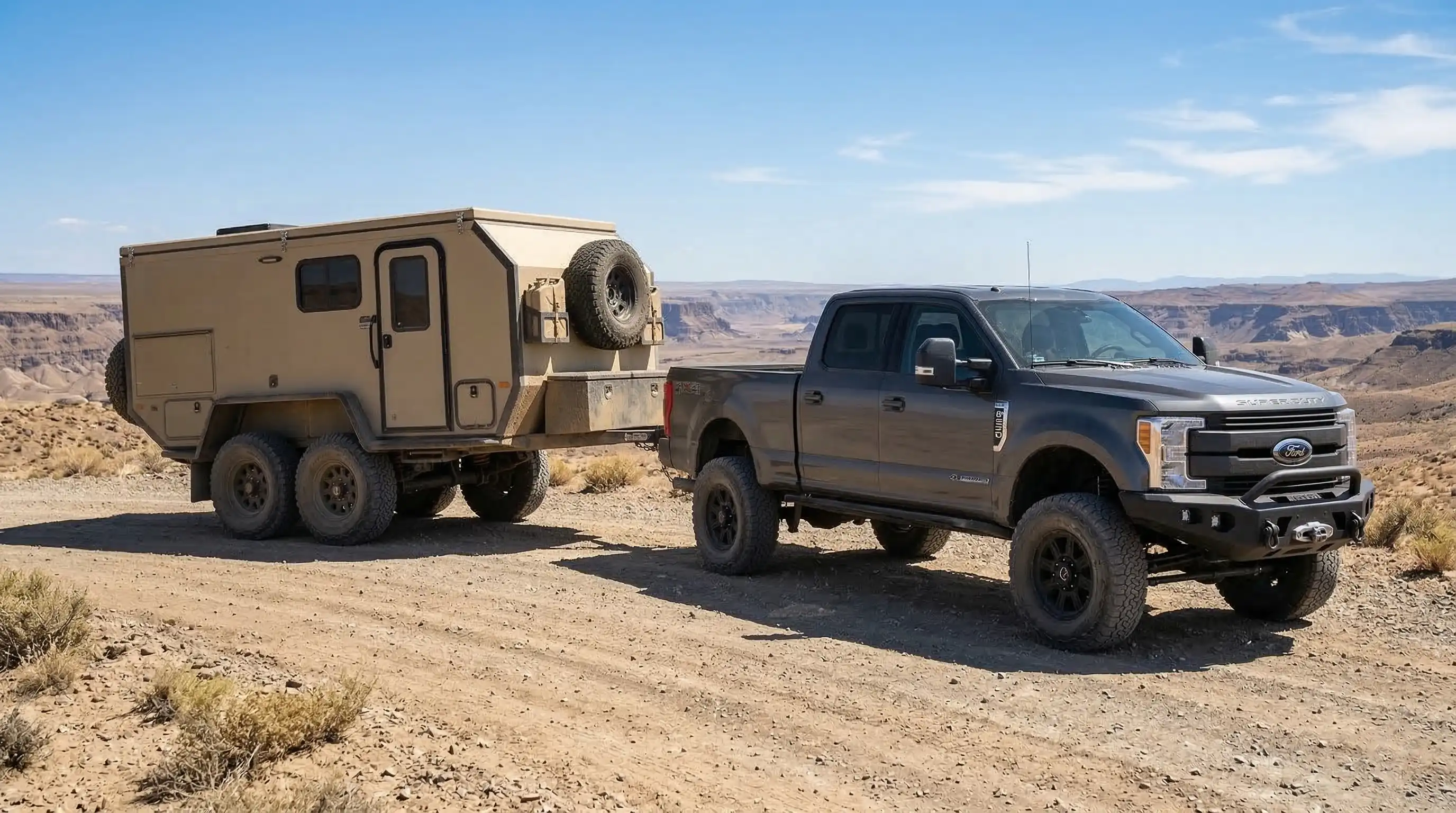
Geometric Limits of Articulating Hitches
Taking a ruggedized, single or dual-axle camper trailer (such as a Black Series or Bruder) into the deep BLM backcountry requires an absolute severance from the traditional 2-inch ball hitch. Standard ball hitches bind and fracture at approximately 15 to 20 degrees of vertical or lateral articulation. When navigating washed-out ravines or steep rocky inclines in areas like the Owyhee Desert, your rig will frequently exceed these angles. The veteran standard is a multi-axis articulating hitch, such as the Cruisemaster DO35 or the Lock N Roll system. These mechanical linkages provide 360 degrees of axial rotation and up to 70 degrees of vertical articulation. This mathematical freedom ensures that if your tow vehicle is pitched downward at a 30-degree angle while the trailer is still cresting a ridge, the immense torsional load is not transferred to your tow vehicle's frame rails, preventing catastrophic chassis deformation.
48V Electrical Architectures for High-Draw Trailers
Rugged camper trailers are increasingly serving as mobile basecamps for extended off-grid stays, demanding power for induction cooktops, dual-zone 12V refrigeration, and off-road air conditioning. Pushing these loads through a traditional 12V architecture requires impossibly thick 4/0 AWG cabling to prevent severe voltage drop. The expert boondocker is migrating to a 48V DC bus. By quadrupling the voltage, you divide the amperage required by four (following Watt's Law, P=VI). This drastically reduces the I2R heat losses in your wiring harness. A 48V system built on a 10kWh LiFePO4 rack-mounted server battery bank, paired with a high-frequency 5000W inverter (like a Victron Quattro or EG4), provides grid-level stability. To integrate legacy 12V systems (water pumps, LED lighting), a commercial-grade 48V-to-12V step-down buck converter is utilized, creating an uncompromising, split-voltage micro-grid.
Dynamic Tongue Weight and Washboard Physics
Corrugated BLM access roads—the dreaded 'washboard'—are the ultimate destroyer of rugged trailers. The kinetic physics involved are punishing. When driving over washboards, the trailer's unsprung mass creates upward vertical acceleration. If your shock absorbers undergo 'fade' due to oil cavitation from overheating, this kinetic energy transfers directly into the trailer frame. Furthermore, dynamic tongue weight fluctuates violently. A static tongue weight of 600 lbs can briefly spike to over 1,800 lbs of downward force when hitting a deep rut at 20 mph. Tow vehicles must be equipped with heavy-duty, progressive-rate rear coil springs or load-leveling airbags to prevent bottoming out the bump stops. Additionally, the trailer's tire pressure must be aired down based on a specific load-inflation table to increase the tire's sidewall flex, turning the tire itself into the first stage of the suspension system.
Active Thermal Management for Battery Bays
Deep-cycle LiFePO4 batteries are highly sensitive to thermal extremes. In the Mojave Desert, external compartments can easily reach 140 degrees Fahrenheit, while high-altitude Rockies locations can plunge well below freezing. A rugged trailer must feature a hermetically sealed, actively managed electronics bay. Veterans use 12V thermoelectric (Peltier) coolers or dedicated ducting from the cabin's climate control system to keep the BMS operating within its optimal 60-to-80 degree window. Charging lithium below 32 degrees Fahrenheit without an internal heating matrix will cause irreversible lithium plating on the anode, instantly killing a $5,000 battery bank. Relying on passive ventilation is a beginner's mistake that guarantees premature system failure.
Legal Road Classifications and Recovery Liabilities
Not all BLM dirt is created equal. The Motor Vehicle Use Map (MVUM) dictates exact road classifications. Taking a 6,000-pound rugged trailer onto a trail designated for 'Vehicles 50 inches or less in width' is a federal violation under the Federal Land Policy and Management Act (FLPMA). Beyond citations, the logistics of a recovery operation are severe. If you snap a trailing arm or blow a hub on a Tier 3 trail, standard tow trucks cannot reach you. Off-road recovery services utilize tracked vehicles and kinetic snatch blocks, and extricating a dead trailer from deep BLM land will routinely exceed $5,000 to $10,000. You are legally liable for any environmental damage caused during the extraction process. Veterans carry specialized tools, including spare bearing packs, heavy-duty ratchet straps for improvised suspension splints, and a portable MIG welder powered by their 48V inverter to perform backcountry mechanical triage.