

The Engineering of Total Water Autonomy
In primitive BLM sites, there is no 'tap' for 50 miles. For a seasoned veteran, a 50-gallon fresh tank is merely a starting point. To achieve a 14-day stay without resupply, you must implement 'Cascade Water Usage.' This involves a three-stage filtration system: a 5-micron sediment filter, an activated carbon block, and a final UV-C stage. Graywater is not waste; it is a resource. By utilizing a grease trap and a portable ozone generator, graywater can be repurposed for 'utility tasks' such as cleaning solar panels or flushing the toilet (if not using a dry system). The goal is to reduce your consumption to less than 1.5 gallons per person, per day, through high-pressure, low-flow 0.5 GPM aerators.
Solid Waste Management: Incineration vs. Desiccation
Primitive BLM sites (especially in the 'High Desert' and 'Great Basin' districts) are increasingly sensitive to human waste. The old 'cat hole' method is biologically irresponsible in arid soils. The expert boondocker utilizes a 12V or propane-powered incineration toilet (like the Cinderella) or a high-end diverting/desiccating system. Incineration is the gold standard for primitive sites as it leaves only a handful of sterile ash, eliminating the need to haul a heavy black tank over Tier 3 roads. If using a desiccating system, the 'solids' must be treated with a coco-coir medium and kept at 10% moisture to ensure aerobic breakdown, preventing the anaerobic 'sewage' smell common in beginner setups.
Solar Gain and The 'Heat Sink' Problem
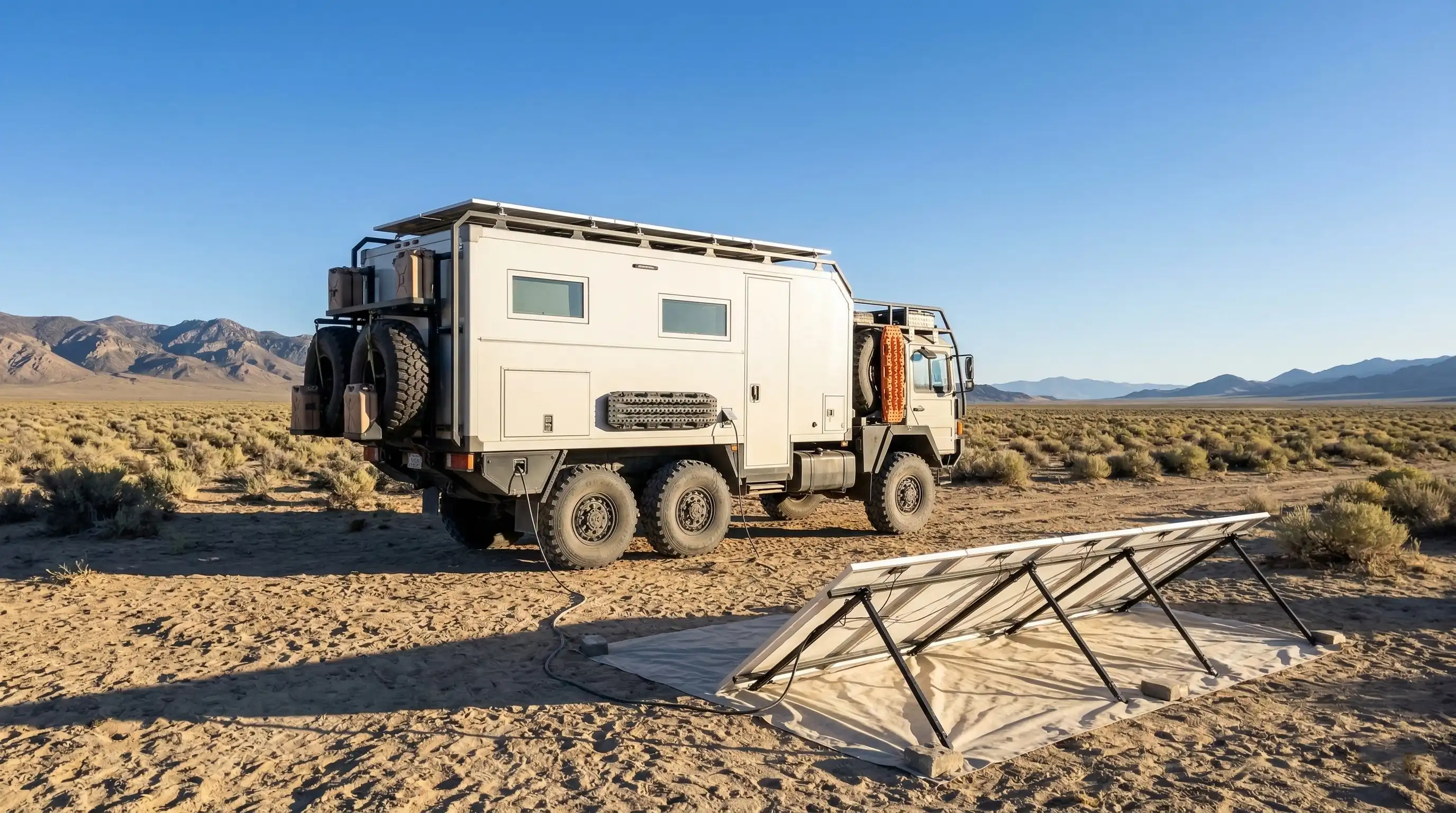
In zero-shade primitive sites, your rig becomes a thermal capacitor. For veterans running 1000Ah+ lithium banks, heat is the enemy of capacity. You must utilize 'Active Venting' in your battery compartment, triggered by a 12V thermostat. To maximize solar gain without roasting the interior, utilize 'Solar Air Gapping.' This involves mounting panels on a rail system that is at least 3 inches above the roof skin, allowing convective airflow to carry away the heat. For ground arrays, utilize bifacial panels over a light-colored 'ground cloth' to catch the Albedo reflection, increasing your total energy harvest by up to 15% in sandy or rocky environments.
RF Autonomy: Starlink and 5G Load Balancing
Primitive doesn't mean disconnected. In the 'back-of-beyond,' signal stability is paramount. The expert setup utilizes 'WAN Smoothing.' By using a dual-modem router (like a Peplink MAX BR1 Pro 5G), you can bond a Starlink signal with a low-bandwidth, high-penetration 600MHz (Band 71) cellular signal. This ensures that if the Starlink dish experiences a 'micro-obstruction' from a single Joshua Tree, your Zoom call or data stream doesn't drop. For the Starlink dish itself, the 'Flat Mount' modification is preferred for primitive sites, reducing the wind load and the power-hungry 'alignment' motors that can consume an extra 20W of precious battery capacity.
BLM 43 CFR 8365.1-1 Compliance
Under federal mandate 43 CFR 8365.1-1, you are prohibited from 'creating a nuisance.' In primitive sites, this specifically applies to sound and light pollution. The seasoned veteran utilizes a silent 'Inverter/Charger' system (like a Victron MultiPlus-II) rather than a generator. If a generator is required for emergency bulk charging, it must be housed in a 'baffle box' to reduce the decibel level to under 60dB at 50 feet. For lighting, utilize high-CRI (Color Rendering Index) amber LEDs to minimize the impact on the local nocturnal ecosystem, ensuring you remain a low-profile, high-efficiency 'ghost' on the landscape.