
The Mojave Micro-Climate and Electronic Thermal Load
The Las Vegas BLM districts, specifically near Lovell Canyon and the Jean Dry Lake beds, present a unique set of challenges for high-end electronics. In the Mojave, the ambient air temperature often approaches the 'thermal shutdown' threshold of standard 2000W-3000W inverters. To prevent derating, your inverter should be mounted with a minimum 3-inch clearance on all sides and equipped with an external 12V high-static-pressure fan. For those running 48V systems, the efficiency gains are significant, but the heat generated by the DC-DC converters during high-current charging from the alternator can exceed 160°F if not actively cooled. In 2026, the 'Gold Standard' is the use of phase-change material (PCM) heat sinks mounted to the back of the charge controllers to buffer the mid-day heat spike.
Electrical Safety: The Caliche Soil Earthing Problem
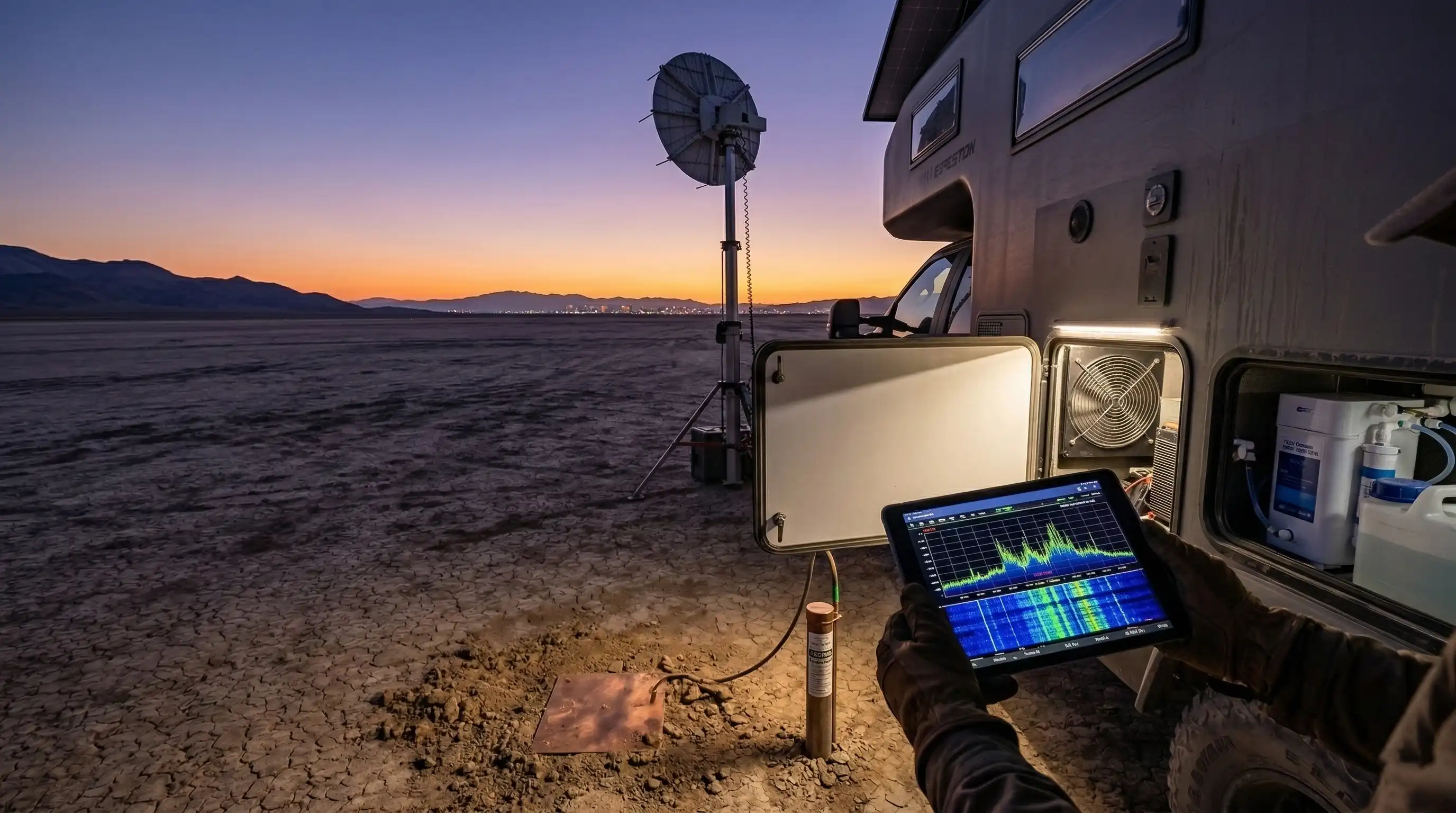
One of the most overlooked aspects of Nevada boondocking is proper electrical grounding. The soil near Vegas is often 'caliche'—a hardened layer of calcium carbonate. Caliche is an extremely poor conductor of electricity, making a standard 3-foot ground rod almost useless. This is critical for those using Starlink or high-gain 5G antennas, which are susceptible to static buildup during dust storms. In 2026, the technical workaround is the 'Grounding Plate' or a 'Chemical Ground Rod' that utilizes moisture-retaining salts to lower soil resistivity. If you are parked on a dry lake bed, ensure your rig's chassis is bonded to your electrical ground to prevent 'hot skin' syndrome caused by static friction from wind-blown sand particles.
RF Signal Propagation and the Vegas Basin Interference
While proximity to Las Vegas offers excellent 5G coverage, the 'Noise Floor' in the 600MHz to 2.5GHz bands is incredibly high due to the density of commercial RF traffic. For the remote worker, a standard 'booster' (like a WeBoost) will often struggle because it amplifies the noise along with the signal, leading to a poor Signal-to-Noise Ratio (SNR). The expert solution is a 4x4 MIMO directional antenna (like the Poynting EPNT-2) paired with a Cat-20 or 5G modem. By using a directional antenna to 'null out' the interference from the Vegas strip and focusing on a specific cell tower in the Pahrump or Henderson periphery, you can achieve 300Mbps+ speeds even in congested areas.
Dust Management and Filtration Logistics
Mojave dust is alkaline and ultra-fine (under 2.5 microns). It will bypass standard RV door seals and clog the intake filters of your A/C and electronics. Technical boondockers in 2026 are now utilizing 'Positive Pressure' systems—small, filtered blowers that keep the interior of the RV at a slightly higher pressure than the outside air, preventing dust from 'seeping' in through gaps. For your engine and generator, replace standard paper filters with 'high-dust-capacity' dry synthetic media. Avoid oiled filters (like K&N), as the Mojave dust will create a 'mud' on the filter surface, choking the engine's air intake and reducing fuel economy by up to 15%.
2026 Nevada Water Security
Water access in the Nevada BLM zones has been restricted in 2026 due to the ongoing Colorado River compact adjustments. Traditional 'Free' water taps in parks are being replaced by metered, pay-by-app systems. For a 14-day stay, the expert must implement a strict 'Greywater Recycling' protocol. Utilizing a portable reverse osmosis (RO) unit to process shower water back into 'utility water' for toilet flushing can extend your 50-gallon fresh tank by an additional 7 days. Note: Ensure your RO brine is disposed of in a sealed container; dumping high-concentration mineral brine on Mojave soil is a violation of 'Leave No Trace' principles as it prevents native seed germination.