
The Physics of Plasma Arc Technology
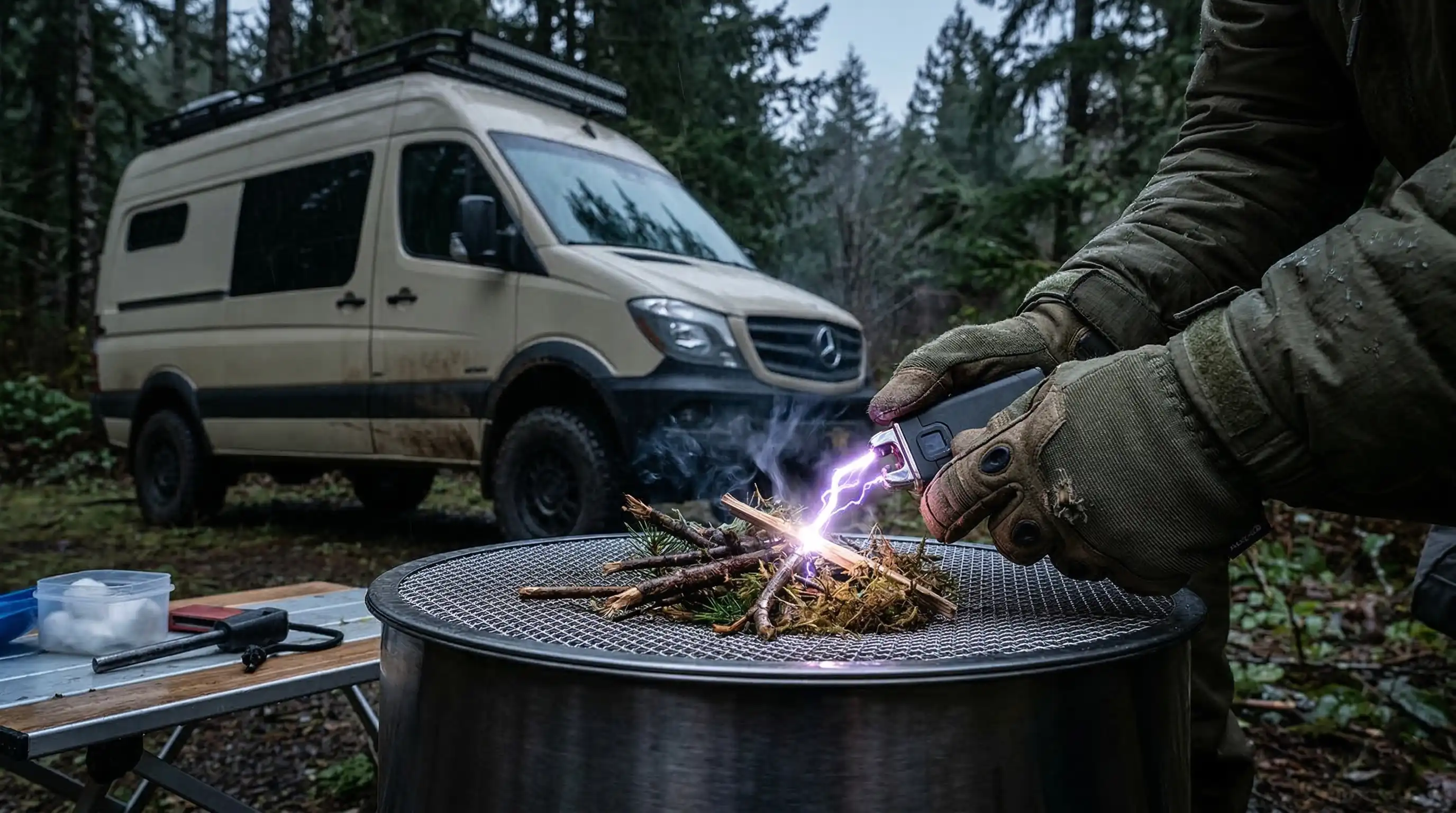
In the high-velocity wind corridors of the Wyoming BLM plains or the deep slot canyons of Utah, traditional butane lighters are rendered useless due to wind shear and the severe drop in vapor pressure at high altitudes. For the technological off-gridder, the 2026 standard is the dual-arc plasma lighter. These devices operate on the principles of high-voltage dielectric breakdown. An internal step-up transformer converts the 3.7V from an internal lithium-ion cell (typically an 18650 or high-drain 21700 cell) into thousands of volts. This massive potential difference across four closely spaced electrodes tears electrons from the air molecules, ionizing the gas and creating a conductive plasma arc. This plasma reaches temperatures exceeding 2,000°F (1,100°C) and is completely impervious to wind, as there is no gaseous fuel to blow away. However, the veteran must understand the battery chemistry: at temperatures below 10°F, the internal resistance of the lithium-ion cell spikes, causing a massive voltage sag that will fail to initiate the arc. Plasma lighters must be kept inside internal jacket pockets (utilizing metabolic body heat) until the exact moment of ignition.
Metallurgy of Ferrocerium and Pyrophoric Alloys
When electronic systems fail due to extreme cold or EMP (Electromagnetic Pulse) considerations, mechanical pyrophoric alloys are the ultimate fail-safe. A 'ferro rod' is not merely flint; it is a complex metallurgical alloy known as Ferrocerium, composed roughly of 50% Cerium, 25% Lanthanum, and 19% Iron, with traces of Praseodymium and Neodymium. Cerium has an incredibly low ignition temperature of approximately 300°F. When struck by a sharp, high-carbon steel striker (or the 90-degree spine of a survival knife), the friction shears off microscopic ribbons of the alloy. The heat generated by the friction causes the Cerium to instantly oxidize (burn) in the atmosphere, producing a shower of molten sparks that burn at an astonishing 5,430°F (3,000°C). This extreme thermal energy is required to push damp, recalcitrant tinder past its activation energy threshold in wet Pacific Northwest BLM forests. The technical requirement is to use a slow, heavy-pressure scraping motion to shave off *large* molten globs, rather than rapid, light strikes that only produce fast-cooling microscopic sparks.
Exothermic Chemical Ignition Systems
For extreme survival logistics, such as rendering aid during a backcountry recovery or signaling in a whiteout blizzard, mechanical friction is sometimes too slow. The expert boondocker carries exothermic chemical accelerators. The most stable and calorically dense option is a suspension of hexamine or specialized petroleum-infused fibrous tinders. Hexamine ($C_6H_{12}N_4$) burns smokelessly, requires no localized oxygen aside from the ambient air, and has a high energy density of approximately 30 MJ/kg. Alternatively, combining Potassium Permanganate ($KMnO_4$) with a polyol like Glycerin ($C_3H_8O_3$) creates a violent, spontaneous, and highly exothermic redox reaction. This chemical fire-starting method requires no external spark or heat source, making it an invaluable tool for an operator with compromised motor skills due to severe hypothermia, though it requires strict compartmentalized storage to prevent accidental vehicle immolation during washboard transit.
Wind Fluid Dynamics and Tinder Architecture
Generating a 5,000°F spark is useless if the initial combustion is immediately blown out by a 40 mph desert gust. The physics of fire building require a mastery of fluid dynamics. The expert utilizes a 'turbulent boundary layer' construction. By excavating a slight depression and building a rigid wind-break of dense rocks or green wood, you alter the laminar flow of the wind, creating an eddy (a vortex of slower-moving air) directly over the tinder bundle. The tinder itself must follow the 'Surface Area to Mass Ratio' rule. Utilizing extremely fine, mechanically processed fibers (like scraped magnesium shavings or natural fatwood dust) maximizes the surface area available for rapid oxidation, allowing the initial spark to instantly transition into a self-sustaining exothermic chain reaction before the wind can strip the thermal energy away.
BLM 43 CFR Part 9212: Legal Open Flame Compliance
The ability to summon fire is heavily regulated across all BLM territories under 43 CFR Part 9212. During the dry season, nearly all Southwest BLM districts enter strict fire restrictions. Under Stage 1 restrictions, fires are typically only allowed in improved, agency-provided fire rings (which do not exist in dispersed boondocking). Under Stage 2, all open flames, including the use of raw ferrocerium rods or exothermic chemical starters to ignite natural ground fuels, are federal crimes. Spark-producing tools must be heavily scrutinized. If an errant 5,000°F ferrocerium spark lands on a bed of dry cheatgrass, the resulting flash fire can consume hundreds of acres in minutes. Off-grid experts strictly limit their fire-starting practice to contained, raised, metal fire pits (like a portable Solo Stove or Pop-Up Pit) that sit above the ground and feature a mandatory, federally approved spark arrestor screen to prevent flying embers from escaping the combustion zone. Ignorance of the local fire order is not a valid legal defense.