

The Deception of EN/ISO Temperature Ratings
Relying on the marketing text printed on a sleeping bag stuff sack is a fatal error in deep-winter boondocking. The EN 13537 (and updated ISO 23537) standards utilize a heated copper mannequin to test thermal resistance. However, these tests assume the user is wearing base layers, a hat, and utilizing an insulating pad with an R-value of at least 4.8. For the seasoned veteran, the 'Limit Rating' is the absolute edge of hypothermic survival, not comfort. The 'Comfort Rating' is the only metric that matters for restorative sleep. Furthermore, these tests do not account for the specific humidity of the BLM high-desert or the localized drafting inside a camper shell. An expert sleep system is built on modularity—layering a high-loft 850-fill hydrophobic down inner bag inside a synthetic over-quilt. The synthetic outer layer pushes the 'dew point' outside of the down insulation, preventing condensation from compromising the down's loft during multi-day zero-degree stays.
Managing Insensible Perspiration with VBLs
At minus 10 degrees Fahrenheit, the human body still excretes approximately half a liter of moisture per night through 'insensible perspiration.' In extreme cold, this water vapor travels outward through your base layers and freezes as it hits the dew point within the down clusters of your sleeping bag. Over a 14-day BLM stint, your bag will accumulate pounds of ice, completely destroying its thermal efficiency. The hardcore technical solution is the Vapor Barrier Liner (VBL). A VBL is a non-breathable sack (often sil-nylon) worn directly over a lightweight base layer, trapping 100 percent of the moisture against your skin. While initially clammy, it completely halts evaporative heat loss and guarantees your primary insulation remains bone dry and fully lofted. VBLs are mandatory tech for extended sub-zero autonomy without access to a tumble dryer.
Conductive Heat Loss and R-Value Summation Mathematics
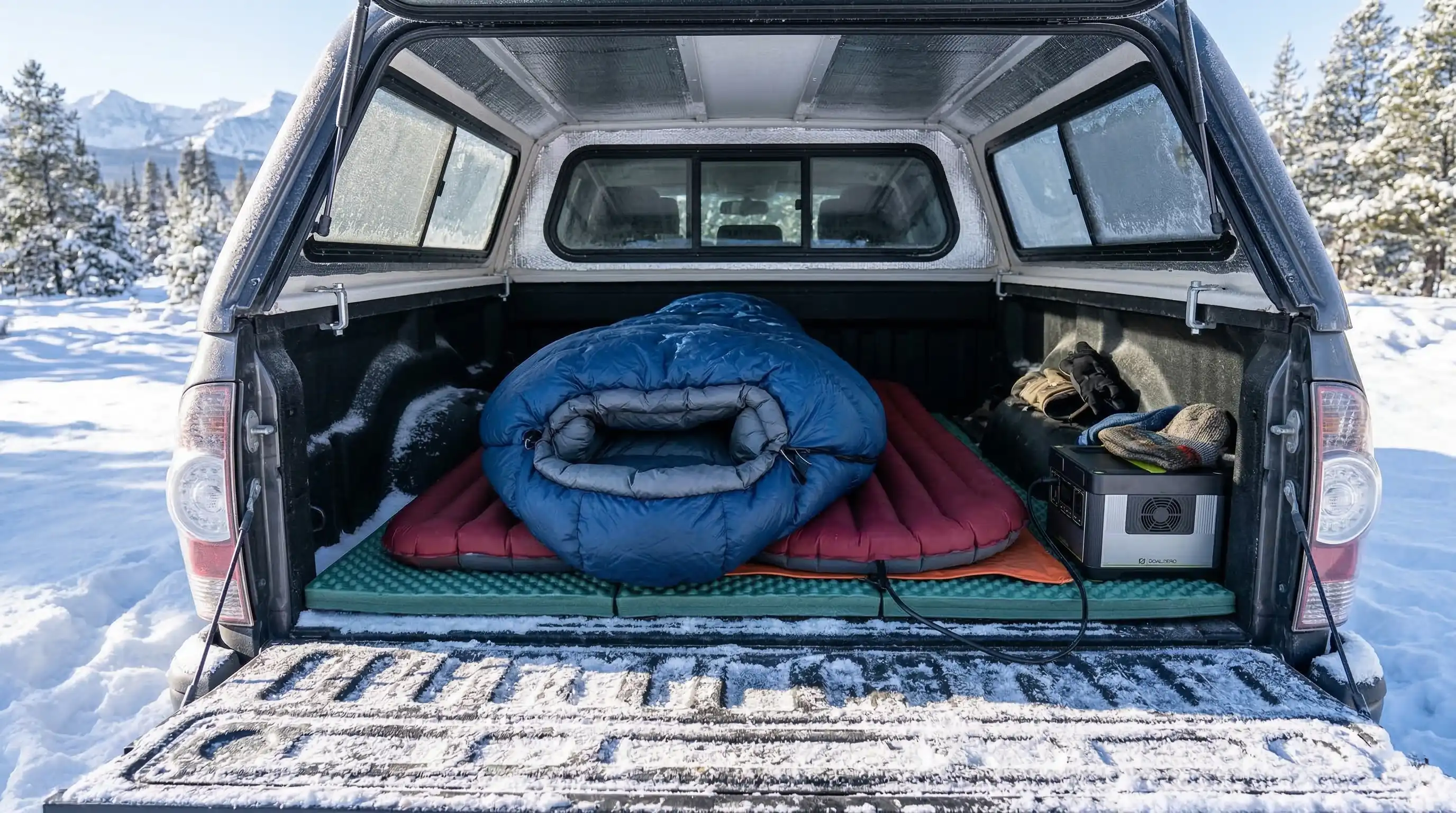
The ground (or the uninsulated floor of a truck bed) is an infinite heat sink. You will lose exponentially more body heat via conduction to the ground than via convection to the air. The thermal resistance of your sleeping pad is measured in R-value. For winter boondocking on frozen earth, an R-value of 6.0 is the absolute minimum. Expert logistics dictate 'R-value Summation'—stacking a closed-cell foam pad (like a Therm-a-Rest Z Lite, R-value 2.0) beneath a high-end inflatable winter pad (like an XTherm, R-value 7.3). Because R-values are additive, this combination yields an impenetrable 9.3 R-value barrier. The closed-cell foam pad also provides a fail-safe mechanical barrier; if the inflatable pad punctures on a rogue piece of gear, the foam ensures you do not die of hypothermia via direct contact with the freezing chassis floor.
Integrating 12V LiFePO4 Heating Matrices
For those sleeping in the back of an unheated topper or minimalist teardrop, the ultimate thermal hack is active electronic heating. Rather than relying solely on metabolic heat, veterans are wiring 12V carbon-fiber heating matrices directly under their sleeping pads. By drawing power from a dedicated LiFePO4 power station (e.g., an EcoFlow or custom 100Ah battery box), these pads provide a continuous 30W to 50W of radiant heat. Because the heat is trapped beneath the heavy insulation of the sleeping bag, it effectively turns the entire bed into a thermal cocoon. You must use a pulse-width modulation (PWM) controller to dial the output to precisely match the ambient drop, ensuring you do not sweat (which ruins the system) and that your battery bank has enough capacity to survive a 14-hour winter night.
Respiratory Heat Loss and Frostbite Mitigation
A frequently ignored vector for hypothermia is respiratory heat loss. Breathing sub-zero air pulls massive amounts of thermal energy from your core. Burying your face deep inside the sleeping bag is a disastrous amateur move, as your breath will rapidly soak the down insulation with condensation. The technical protocol requires a structural draft collar to seal the bag around your neck, keeping metabolic heat trapped below the clavicle. Your face must remain outside the bag, protected by a specialized balaclava or an insulated 'elephant foot' hood. Additionally, a frost bib—a small piece of fleece draped over the breathing portal—is used to catch the moisture from your exhalations, freezing harmlessly on the fleece rather than forming a sheet of ice on the exterior shell of your $800 sleeping bag.