

The Physics of Slot Canyon Signal Propagation
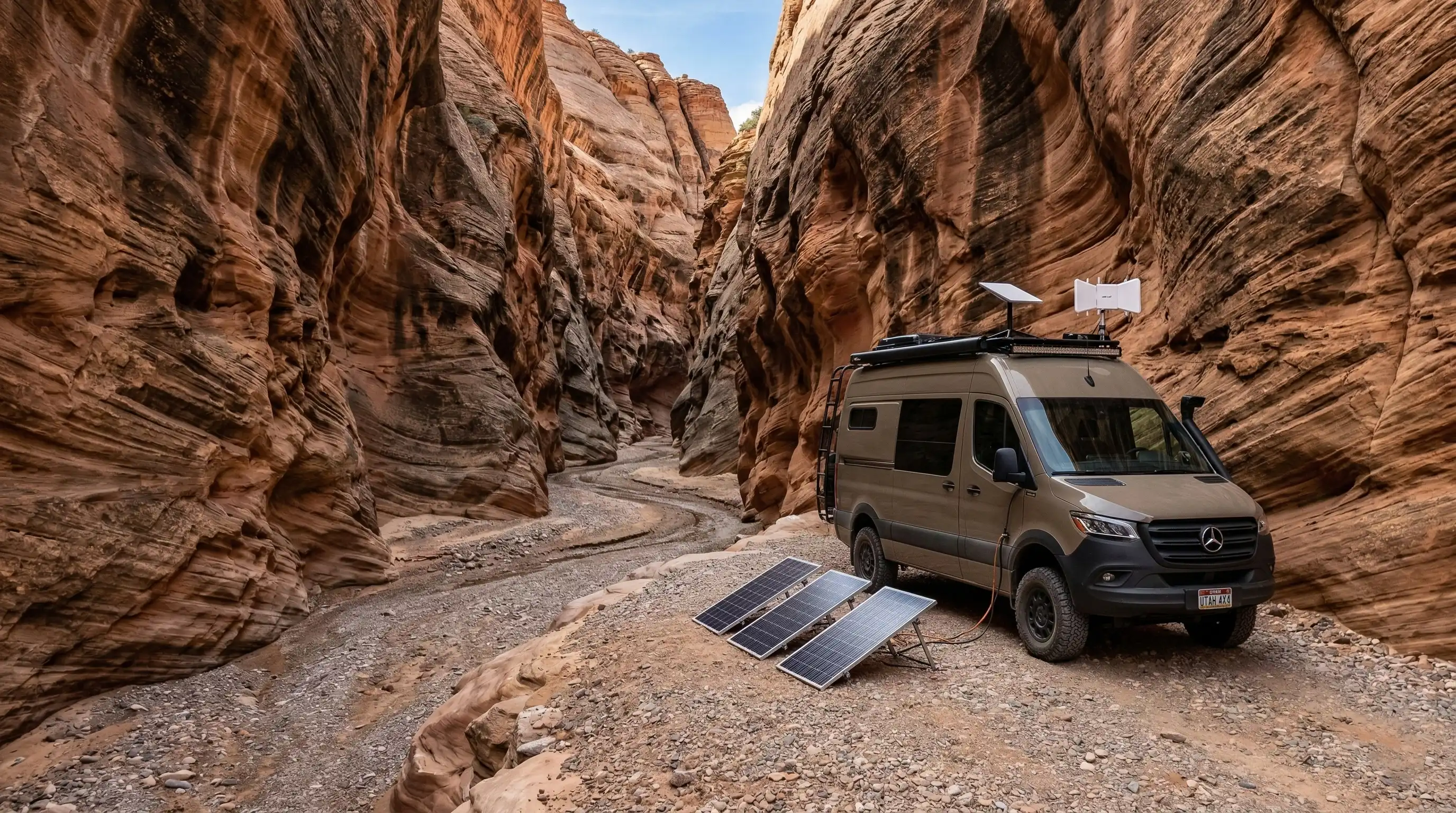
Boondocking in the deep sandstone corridors of the San Rafael Swell or the Paria River basin introduces a phenomenon known as 'multipath interference.' For the seasoned veteran, relying on a standard omnidirectional antenna is a recipe for high packet loss. In a slot canyon, the signal doesn't arrive in a straight line; it bounces off sheer rock walls, creating phase shifts that confuse modern 5G modems. To overcome this, the expert must utilize a highly directional 4x4 MIMO array (like the Poynting EPNT-1) and perform a 'Signal Sweep' to find the specific rock face providing the best reflective gain. This is not about pointing at the tower; it is about pointing at the wall that the tower is hitting.
Starlink and the 110-Degree North Sky Mandate
Starlink connectivity in a canyon is a game of geometry. With Gen 4 hardware, the field of view required is approximately 110 degrees. In a slot canyon where the width-to-height ratio is less than 1:2, your 'uptime' will be determined by the satellite's orbital crossing period. By using the Starlink app's occlusion tool, you can calculate the 'window of connectivity.' If your window is only 15 minutes per hour, you must implement a 'Batch Data' strategy: use a local NAS (Network Attached Storage) to queue all uploads and downloads during peak visibility, coupled with a high-capacity capacitor bank to handle the dish's snow-melt mode startup surges in the cool canyon air.
Hydrology and Flash Flood Kinetic Energy
Seasoned RVers know that slot canyons are drainages. However, an expert understands the 'Basin Saturation' index. Before committing a 15,000lb rig to a canyon floor, you must analyze the Nexrad Radar data for the entire upstream drainage basin, which may be 50 miles away. A 10% saturation of the upper plateau can result in a 2-foot wall of water moving at 15 feet per second within the canyon. We recommend installing an ultrasonic water level sensor 500 yards upstream, integrated into your rig's alarm system via LoRaWAN, providing a critical 120-second warning to move to high ground (the 'benches').
Solar Mathematics in Low-Irradiance Corridors
In a canyon, your 'Peak Sun Hours' (PSH) may drop from 6.2 to a mere 1.5. To maintain a 1200Ah LiFePO4 bank, you cannot rely on rooftop panels. The expert solution is 'Remote Solar Staging.' Utilizing 10-gauge PV extension cables, you must deploy ground-mounted bifacial panels on the canyon rim or the sun-drenched western shoulder. This requires a high-voltage MPPT controller (150V or higher) to minimize the I2R (line) losses over a 100-foot run. If you cannot reach the rim, you must calculate your 'Energy Budget' based on the specific solar zenith angle during your 90-minute window of direct light, focusing on maximum C-rate charging to 'bulk' the batteries quickly.
Legal Mandates and Cryptobiotic Ethics
The BLM 'Canyon Country' districts (like Moab and Price) have strictly enforced 'Riparian Buffer' zones. Under 43 CFR 8365.1-6, you must be at least 200 feet from water sources. However, in slot canyons, the 'water source' is often the road itself. Veterans must ensure they are parked on 'slickrock' or gravel benches to avoid crushing cryptobiotic soil. In 2026, rangers are utilizing thermal drones to detect 'graywater plumes' in the sandy canyon floors; a closed-loop waste system is not just an ethical choice, it is a legal requirement for avoiding $500 'Resource Damage' citations.