

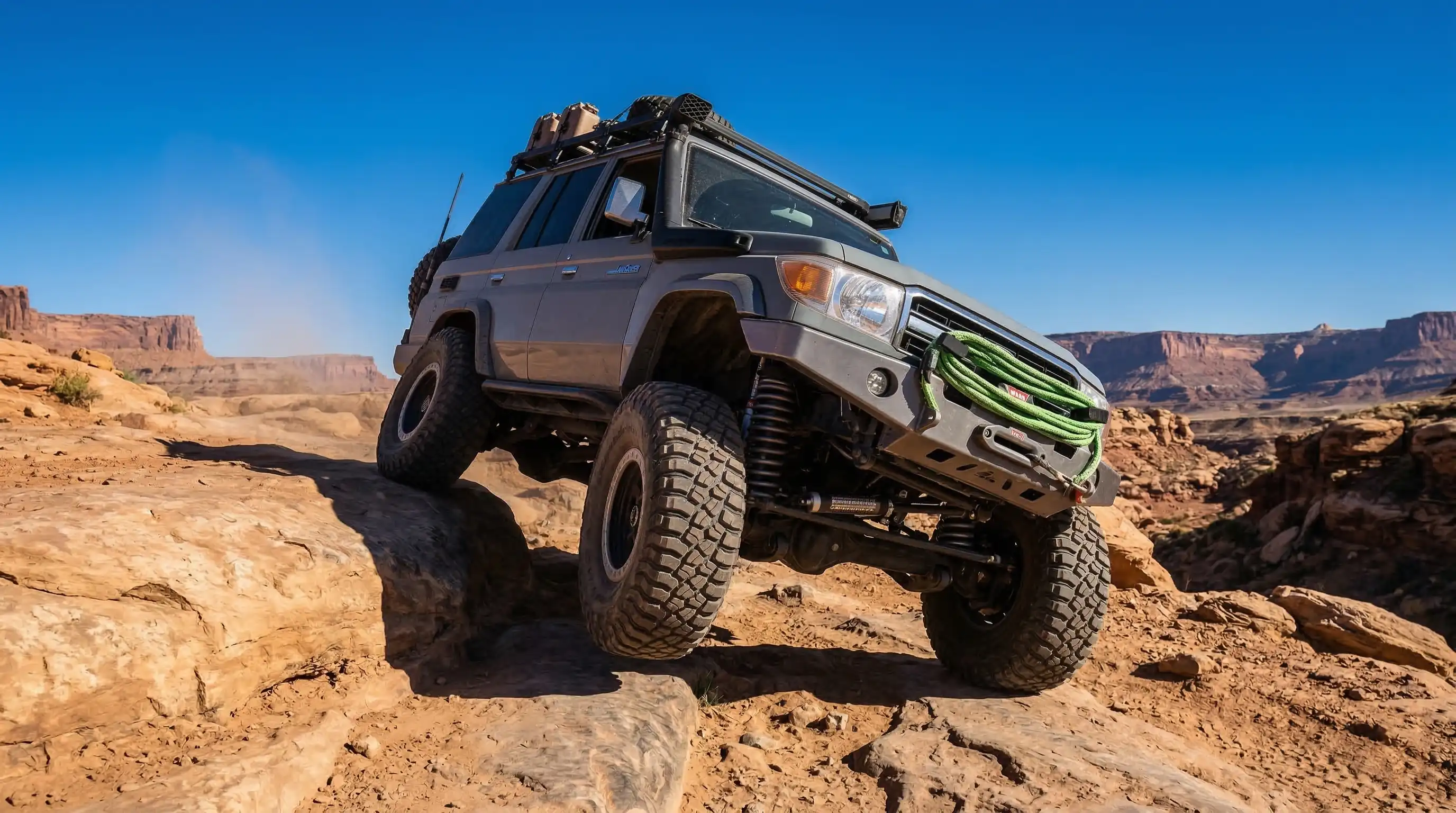
Trigonometry of Clearance: Approach, Departure, and Breakover
Entering deep BLM territory via 'jeep trails' or washed-out fire roads requires a strict understanding of vehicle geometry, specifically the holy trinity of clearance: Approach, Departure, and Breakover angles. A 3-inch suspension lift is meaningless if your bumper overhangs severely. The Approach Angle is the maximum ramp angle you can climb without the front bumper striking the obstacle. The Breakover Angle is dictated by your wheelbase and belly clearance; an elongated wheelbase (like a full-size truck pulling a camper) severely reduces the breakover angle, practically guaranteeing you will 'high-center' on steep ridge crossings. The expert off-gridder calculates these angles precisely and utilizes welded rock sliders capable of supporting the full static weight of the vehicle, allowing them to intentionally drag the belly over obstacles without destroying the transmission pan or the delicate transfer case.
Contact Patch Mathematics and Airing Down
Tire pressure is not a suggestion; it is a dynamic tool. When you transition from tarmac to a sandy BLM wash in Utah, maintaining 60 PSI will cause the tires to act like trenching tools, digging straight down to the axles. By 'airing down' to 15-20 PSI, you are not merely making the ride softer; you are fundamentally altering the physics of traction. Decreasing tire pressure elongates the tire's footprint longitudinally, expanding the 'contact patch' area by up to 300 percent. This massive increase in surface area radically drops the vehicle's Ground Pressure (measured in PSI against the earth), allowing a 7,000-pound rig to float on top of silt or deep sand. To manage this safely, beadlock wheels or heavy-ply tires are necessary to prevent the tire from unseating from the rim, and a high-duty-cycle dual air compressor is mandatory for rapid reinflation before highway speeds overheat the compromised sidewalls.
The Physics of Kinetic Energy Recovery
When an expert gets stuck—and they will—static towing with a rigid strap or chain is incredibly dangerous and often ineffective due to shock loading. The modern standard is Kinetic Energy Recovery. Using a specialized nylon or Dyneema rope (often called a 'snatch rope'), the recovery vehicle generates momentum before the line goes taut. The kinetic rope stretches up to 30 percent of its length, acting like a massive rubber band. It stores the kinetic energy of the moving recovery vehicle and smoothly transfers it as elastic potential energy to the stuck vehicle. The math is brutal: a 10,000-pound truck moving at 5 mph generates enormous force. All recovery points must be chassis-welded and rated for a Minimum Breaking Strength (MBS) of at least three times the vehicle's Gross Vehicle Weight Rating (GVWR) to prevent a shackle from shearing off and becoming a lethal projectile.
Winch Load Multipliers and Snatch Blocks
A 12,000-pound winch is only rated for 12,000 pounds on its innermost drum layer. As the cable spools outward, the leverage changes, and the pulling capacity drops drastically. If you are mired in axle-deep mud on a BLM logging road, the suction force can require a pull equivalent to twice your vehicle's weight. The technical solution is mechanical advantage via a snatch block (pulley). By running the winch line out to a tree-saver strap on a solid anchor, through a snatch block, and back to the vehicle, you effectively double your pulling power and cut your line speed in half. This 2:1 mechanical advantage is the only way to safely extract a heavy expedition rig without stalling the winch motor or snapping the synthetic winch line.
MVUM Compliance and 'Tread Lightly' Liability
The vast network of BLM dirt roads is strictly governed by the Motor Vehicle Use Map (MVUM). These digital or paper maps denote exactly where motorized travel is legally permitted. Following a set of existing tire tracks that veer off the official trail is known as 'trail braiding' and is a direct violation of BLM mandates. As an expert, utilizing GPS applications like OnX Offroad with public land layers is essential. If you traverse off-route to bypass a deep mud hole, you are destroying fragile desert ecosystems and cryptobiotic soils. In 2026, BLM enforcement utilizes satellite imagery and community reporting to cite off-trail violations, which can result in thousands of dollars in fines, vehicle impoundment, and the permanent closure of that trail system to the public. Precision driving and strict adherence to designated routes are the hallmarks of a professional boondocker.